
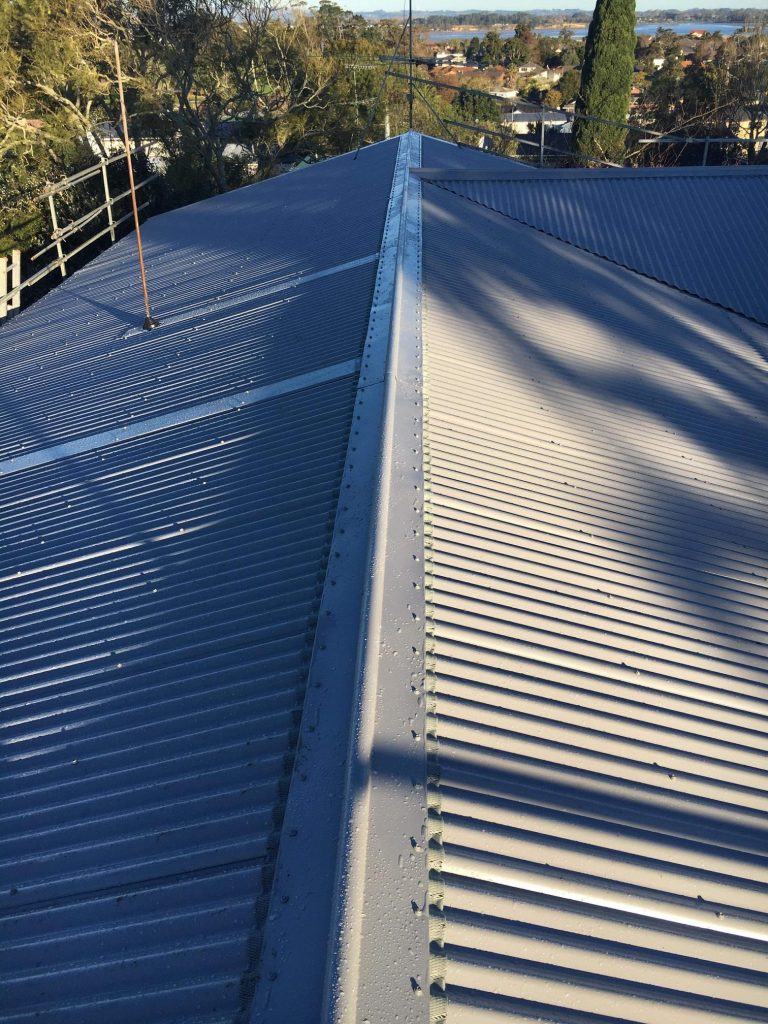
Johnson Roofing investigates metal roof ridge capping failures behind Auckland leaks and scopes repairs for fixings, laps and corrosion.
Ridge leaks can result from loose fixings, inadequate flashing cover, failed end laps, corrosion or defective sheet stop-ends beneath the capping. Because water can travel inside the roof cavity, inspection must confirm the entry path before repairs begin.
How Does Ridge Capping Keep Water Out?
Ridge capping covers the junction where roof planes meet and must work with the roof profile, pitch, fixings and upper sheet ends. Effective detailing relies on correctly formed and secured components that manage wind-driven rain; sealant alone is not a substitute for sound flashing design.
The New Zealand Metal Roofing Manufacturers Code of Practice guidance on stop-ends states that stop-ends are required at the upper end of roofing sheets. It also explains that flashing cover should minimise water ponding associated with deformation around stop-ends. The correct detail depends on the profile and site conditions.
A ceiling stain near the ridge may come from the capping, another flashing, a penetration, damaged sheeting or condensation. We trace the likely route before specifying repairs.
Which Metal Roof Ridge Capping Failures Cause Leaks?
Metal roof ridge capping failures can develop through age, movement, corrosion, storm damage or unsuitable earlier work. Inspection may identify:
- Loose or missing fixings: Movement around screws and washers can create openings or allow the capping to lift.
- Inadequate cover: Capping that does not extend sufficiently over the roof profile may provide weak protection during exposed conditions.
- Defective laps: Poorly formed, damaged or deteriorated joins between capping lengths can admit water.
- Missing or damaged stop-ends: Incorrect sheet turn-ups beneath the ridge may reduce resistance to wind-driven rain.
- Corrosion: Rust affecting the capping, sheet edges or fixings can weaken components and create perforations.
- Distorted components: Foot traffic, impact, thermal movement or unsuitable fastening may affect how the capping sits.
Our guide to metal roof flashings in Auckland explains how ridge, hip, apron and valley flashings perform different roles. A ridge inspection should also consider intersections with hips, barges, penetrations and adjoining flashings.
What Should a Ridge-Capping Repair Scope Include?
A useful repair scope should record the observed defect, proposed materials, access requirements and areas that could not be inspected. Depending on the findings, work may involve replacing fixings, rebuilding laps, forming stop-ends, repairing adjacent sheets or replacing damaged capping.
Material compatibility matters when selecting fasteners, sealants and replacement metal. New work must match the roof profile and account for the supporting substrate. If corrosion or poor detailing extends beyond the ridge, isolated capping repairs may not resolve the full problem.
Our roof maintenance service can assess visible components and identify whether targeted work or a broader re-roofing assessment is appropriate. We cannot promise that every leak will be confirmed during dry weather or without opening concealed areas.
Address Ridge Capping Failures Before Leaks Worsen
Metal roof ridge capping failures should be investigated when leaks recur after wind-driven rain, capping appears lifted or uneven, or corrosion is visible around the ridge. Avoid walking on the roof or applying more sealant without confirming safe access and the defect.
Contact us with your Auckland property address, roof type, leak history and photographs to arrange an inspection and receive a repair or maintenance scope based on the roof’s condition.